
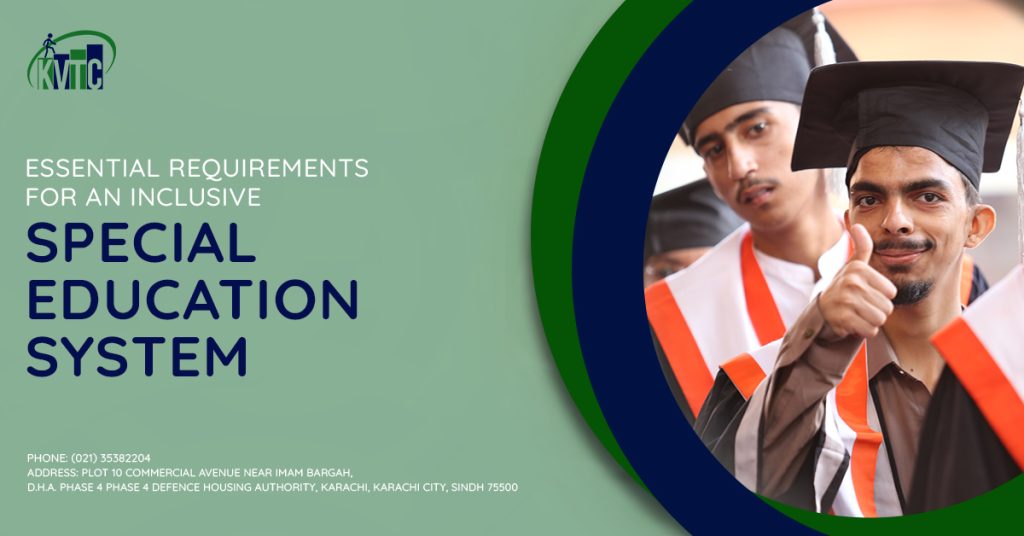
An inclusive special education system ensures that individuals with disabilities receive equitable access to quality education, tailored support, and opportunities to thrive. The Karachi Vocational Training Centre (KVTC) plays a pioneering role in this domain, setting standards for institutions that cater to individuals with special needs. As a leading Special Needs institute in Karachi, KVTC has developed essential requirements for an inclusive special education system, ensuring that students with varying disabilities receive the best possible learning experience.
What is Inclusive Special Education?
Inclusive education is more than just integrating students with disabilities into mainstream schools. It involves creating an environment that fosters acceptance, personalized learning strategies, and necessary accommodations. The success of such an education system depends on multiple factors, including teacher training, infrastructure, adaptive curriculum, and community support.
Essential Requirements for Conducting An Inclusive Education System:
There are multiple factors important to conduct a responsive and well-conducted education system. These ingredients are essential for a well-defined and result-driven education system. Let’s discuss them one by one to understand their worth.
1- Comprehensive Assessment & Individualized Learning Plans:
One of the most critical components of an inclusive education system is the ability to assess students’ needs accurately. KVTC as a topline Special Needs institute in Karachi emphasizes the importance of Individualized Learning Plans (ILPs) tailored to each student’s cognitive, emotional, and physical abilities. This approach ensures that students receive the right guidance and support, allowing them to progress at their own pace.
2- Well-trained & Compassionate Staff:
Teachers and support staff play a crucial role in delivering effective special education. KVTC ensures that educators undergo specialized training in handling students with disabilities. The training focuses on understanding the different types of disabilities, and inclusive teaching strategies.
They develop communication techniques suitable for students with specific multiple needs & provide emotional and psychological support. A well-equipped Special Needs institute in Karachi like KVTC understands that the success of inclusion relies on highly trained professionals.
3- Infrastructure & Technology:
For a special education system to be truly inclusive, the physical environment must be accessible to all students. KVTC has invested in pathways and ramps for wheelchairs and accessible restrooms. They have specially designed classrooms with adaptive seating arrangements. Moreover, they are equipped with assistive technology to facilitate their students, speech-to-text devices and braille readers.
4- Emotional & Psychological Support:
Students with special needs often require additional psychological and emotional support to build confidence and social skills. KVTC provides counseling services for parents and students to respond accordingly to emotional behavior. They have specifically designed social skills training and peer mentoring initiatives to promote inclusivity. They have multiple interesting recreational activities that enhance the emotional well-being of the students.
5- Specified Curriculum & Teaching Strategies:
Traditional curricula may not be suitable for students with special needs. KVTC being the best Special Needs institute in Karachi has adopted an adaptive curriculum that caters to diverse learning styles. Some key aspects include the use of visual and tactile learning and eye-catching material. They also include flexible teaching methods such as experiential learning and play-based instruction. Alternative assessment methods are also a major part of the teaching strategy that considers students’ unique abilities.
6- Vocational Training & Skill Development:
Education should prepare students for independence and self-sufficiency. KVTC incorporates vocational training into its curriculum, enabling students to develop skills that help them secure employment. Some vocational training programs include tailoring, machine embroidery, designing, carpentry, automotive spray paint, kitchen and culinary art, and much more in the bucket.
Conclusion:
Inclusive special education is essential for ensuring that students with disabilities receive the same opportunities as their peers. KVTC has set a benchmark in developing an inclusive education system through individualized learning plans, accessible infrastructure, specialized training, and community engagement. By implementing these essential requirements, KVTC continues to serve as a model Special Needs institute in Karachi, fostering an environment where students with special needs can thrive academically, socially, and vocationally.
—————————————————————————————————————————————————–
FAQs
-
1. What is assistive technology in special education?
Assistive technology (AT) includes tools like speech devices and reading pens that help students with disabilities learn, communicate, and gain independence effectively.
-
2. How does assistive technology benefit students?
AT boosts learning, enhances communication, promotes independence, and builds confidence, enabling students with special needs to thrive in inclusive classrooms.
-
3. What types of assistive technology are available?
From text-to-speech software and adaptive keyboards to noise-canceling headphones and vocational tools, AT caters to diverse needs, supporting learning and daily tasks.
-
4. How does KVTC use assistive technology?
KVTC empowers students with tools like interactive boards, adaptive devices for IT and cooking, and personalized plans, fostering education and job-ready skills.